- 2014 Statewide Education Conference
- Title I Data Retreats
- School Improvement Grant Update
- Consolidated Application Update
- Title I Annual Parent Meeting
- Did You Know: Title I and Title III
- Title I Data Retreats
- School Improvement Grant Update
- Consolidated Application Update
- Title I Annual Parent Meeting
- Did You Know: Title I and Title III
2014 Statewide Education Conference

Title I Data Retreats
In the past, school level data retreats meant meeting as a whole staff to disaggregate data down to the student level and defining bubble students. Some schools evolved the process in to “data digs” where only student achievement was reviewed, forgetting that there are three other lenses of data that should be involved in a data retreat. In today’s world of Focus and Priority schools, SPI scores, increased emphasis of student growth and an overall understanding of the programs available at schools, the evaluation and use of data is even more important than ever. To make the continuous analysis of data to drive instruction more effective, the previous ways of looking at data during a two day data retreat has changed so there is a smooth integration of looking at the four lenses of data aligned with the Seven Turnaround Principles, creating Student Learning Objectives and implementing other initiatives.
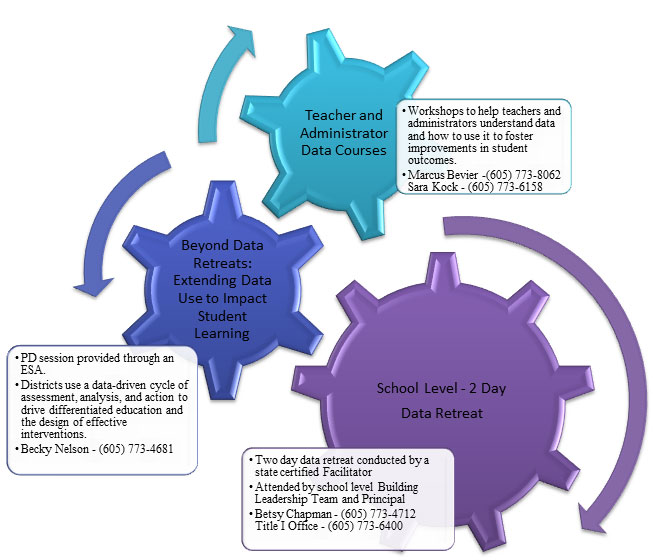
The use of data to drive interventions and instructional change is critical to ensure differentiated instruction and relevant interventions are taking place in the schools. School/Building Leadership Teams should now be the decision makers in the school, using relevant and current data to drive what is happening in the school. The South Dakota DOE is offering several ways for schools to engage in continuous data analysis: 1) School level, two-day data retreats; 2) professional development lead by ESAs; and 3) classes on using data to guide school improvement and/or instruction. For more information, please contact the SD DOE.
The use of data to drive interventions and instructional change is critical to ensure differentiated instruction and relevant interventions are taking place in the schools. School/Building Leadership Teams should now be the decision makers in the school, using relevant and current data to drive what is happening in the school. The South Dakota DOE is offering several ways for schools to engage in continuous data analysis: 1) School level, two-day data retreats; 2) professional development lead by ESAs; and 3) classes on using data to guide school improvement and/or instruction. For more information, please contact the SD DOE.
New Cohort of School Improvement Grants (SIG)
The South Dakota Department of Education is currently in the process of reviewing School Improvement Grant (SIG) Applications for a new Cohort of schools. The new Cohort will begin implementation of the grants starting July 1, 2014 and will receive funds for three years, ending on June 30, 2017.
The School Improvement Grant is a competitive grant available to the currently designated priority and focus schools. The competition opened on February 6 and applications were due on March 24. The districts applied on behalf of the schools, so the application process included both a district-level application and a school-level application. In order to apply, each school chose one of four intervention models to implement, which include the Turnaround Model, Restart Model, Closure Model, and Transformation Model. An outside panel is reviewing applications and providing recommendations based on a rubric.
Awards for this cohort are expected to be announced around May 1. For questions, please contact Shawna Poitra or Jordan Dueis at (605) 773-6400.
The School Improvement Grant is a competitive grant available to the currently designated priority and focus schools. The competition opened on February 6 and applications were due on March 24. The districts applied on behalf of the schools, so the application process included both a district-level application and a school-level application. In order to apply, each school chose one of four intervention models to implement, which include the Turnaround Model, Restart Model, Closure Model, and Transformation Model. An outside panel is reviewing applications and providing recommendations based on a rubric.
Awards for this cohort are expected to be announced around May 1. For questions, please contact Shawna Poitra or Jordan Dueis at (605) 773-6400.
Consolidated Application Update
The 2014-15 Consolidated Application (CA) will be open soon. There are minimal changes to the application this year. It will be due, in a substantially approvable format, July 1, 2014. There will be webinars scheduled soon for those new to completing the CA and for veterans of the process, as well as for small districts with fewer than 1000 students and for those with more than 1000 students.
Please contact Betsy Chapman at (605) 773-4712 or Jordan Dueis at (605) 773-4716 if you have had, or will have, changes in personnel such as the Business Manager or Superintendent. There are certain steps to change the users in the system that are slightly different for those two positions.
Please contact Betsy Chapman at (605) 773-4712 or Jordan Dueis at (605) 773-4716 if you have had, or will have, changes in personnel such as the Business Manager or Superintendent. There are certain steps to change the users in the system that are slightly different for those two positions.
Title I Annual Parent Meeting
Each year, Title I programs are required to host a meeting for parents to explain what the Title I program is and how parents can become involved in the Title I program. At this meeting, the following items must be addressed:
- Explain their school’s participation in Title I
- Explain the Title I requirements
- Explain what participation in Title I programming means, including:
- A description and explanation of the school’s curriculum;
- Information on the forms of academic assessment used to measure student progress; and
- Information on the proficiency levels students are expected to meet.
- Explain the district parental involvement policy, school parental involvement policy, and school-parent compact.
- Explain the right of parents to become involved in the school’s programs and ways to do so.
- Explain that parents have the right to request opportunities for regular meetings for parents to formulate suggestions and to participate, as appropriate, in decisions about the education of their children. The school must respond to any such suggestions as soon as practicable possible.
-Explain how the school will work to develop partnerships with families and communities and how the school will support two way communications between school and home.
In order to keep parents informed, schools must invite all parents of children participating in Title I Part A programs and encourage them to attend. In a school-wide program, this means ALL parents should be invited. Schools must also offer a flexible number of additional parental involvement meetings, such as in the morning or evening so that as many parents as possible are able to attend.
Did You Know?
Title I & Title III
- Explain their school’s participation in Title I
- Explain the Title I requirements
- Explain what participation in Title I programming means, including:
- A description and explanation of the school’s curriculum;
- Information on the forms of academic assessment used to measure student progress; and
- Information on the proficiency levels students are expected to meet.
- Explain the district parental involvement policy, school parental involvement policy, and school-parent compact.
- Explain the right of parents to become involved in the school’s programs and ways to do so.
- Explain that parents have the right to request opportunities for regular meetings for parents to formulate suggestions and to participate, as appropriate, in decisions about the education of their children. The school must respond to any such suggestions as soon as practicable possible.
-Explain how the school will work to develop partnerships with families and communities and how the school will support two way communications between school and home.
In order to keep parents informed, schools must invite all parents of children participating in Title I Part A programs and encourage them to attend. In a school-wide program, this means ALL parents should be invited. Schools must also offer a flexible number of additional parental involvement meetings, such as in the morning or evening so that as many parents as possible are able to attend.
Did You Know?
Title I & Title III
Title III helps ELs attain English language proficiency, so they may access the conventional curriculum and obtain the knowledge and skills to meet state academic standards, while Title I supports the teaching and learning of at-risk students, including ELs, in order to meet academic standards developed by the state?
Title III can only provide language services that are above and beyond both the district’s basic program for ELs and those provided with Title I funds? (Schoolwide Title I programs ensure all students, particularly the lowest-achieving students, improve their academic performance without regard to subgroup or demographic membership. In a targeted assistance program, students are identified for services on multiple educational criteria, and only the most at-risk students are served.)
As long as students remain in the LEP subgroup in Title I regardless of whether ELs attain proficiency under Title III, they must continue to be eligible for Title III services and must participate in the state’s annual ELP assessment, as required under Title I? In order for a student to exit LEP status, the student must attain a 4.7 composite, Reading 4.5 and writing 4.1 on the ELP assessment, ACCESS.
For more information regarding Title III, please contact Yutzil Rodriguez at yutzil.rodriguez@state.sd.us.
Title III can only provide language services that are above and beyond both the district’s basic program for ELs and those provided with Title I funds? (Schoolwide Title I programs ensure all students, particularly the lowest-achieving students, improve their academic performance without regard to subgroup or demographic membership. In a targeted assistance program, students are identified for services on multiple educational criteria, and only the most at-risk students are served.)
As long as students remain in the LEP subgroup in Title I regardless of whether ELs attain proficiency under Title III, they must continue to be eligible for Title III services and must participate in the state’s annual ELP assessment, as required under Title I? In order for a student to exit LEP status, the student must attain a 4.7 composite, Reading 4.5 and writing 4.1 on the ELP assessment, ACCESS.
For more information regarding Title III, please contact Yutzil Rodriguez at yutzil.rodriguez@state.sd.us.